Thursday, October 9, 2014

Fryeburg Fair 2014


As usual, it was fairly challenging to get ready for the Fryeburg on the heels of Common Ground Fair …production of  kits (print instructions, draw, assemble, and count). ....organizing and loading the trailer went well with 4 of us working on it.  We were ready to roll mid afternoon on Thursday including Diva and Delilah in the back of the new truck.   It was late evening and dark when we had finally unloaded onto the porch of the Fiber building at the fair and tucked the lambs in for the night. Mary Ann and Julie headed home and Torey and I went to sleep in the trailer.


Friday was beautiful weather. Torey was in charge of sales and the I-pad.  She made special Halloween designs for the kids to needle felt..a ghost, pumpkin, and bats.  

 We featured some new Holiday Ornaments, cut outs of a sheep, Santa panda and a Christmas tree, complete with a ribbon for hanging on the tree.  Great stocking stuffers.


 Five kids promptly and excitedly chose their colors and made their own Halloween decorations. It was a hit!


 Marty set about dying roving for Thyme Tiles using the camp stove, crockpots and Cushings dyes. 

Angel's yarn was pre- mordented with alum and cream of tarter then dyed with goldenrod, onion skins, marigolds, and amaraynth for some deep yellows. Half barrels held natural dyed yarns with indigo, onion skins, marigolds, and amaraynth. Brazil wood turned out a lovely deep orange.  I found out later that crushed tums (calcium carbonate) would make it redder.  I will try it soon.


Two scarves went into the pots…one with royal blue over gray, red and peacock.  The other Brazilwood over off white and pink, yellow, and blue stripes.  Silk went into the pots also.

Knitted items for sale included Priscilla’s linen stitch hat, cowl, and fingerless mitts, two lovely shawlette’s made by Cheryl, and more.    Kits for knitting include the infamous angora lined hats and Cheryl’s felted slippers and kits.  


Marty's Marvelous Mix of 3 skeins of color coordinated yarn with a free pattern are new.

Friday night was wandering about, food, rabbits, alpaca, llamas, and gypsy wagons ending with grand fireworks. 

Saturday was a drizzling rain most all day.  Sales were still good, and dyeing went well. By the end of the day the freshly dyed roving was piled high on the table on the porch.

Displaying IMG_1861.JPGBy Sunday am we were running out of Starter Needle Felting kits, and around noon Mary Ann and Julie arrived with more.                                                                                                                                                   Mary Ann helped with the indigo vat was made and white and natural gray skeins were dyed for lovely blues and bright yellows from plants were overdyed making some lovely greens.

We made record time packing up and soon enough headed for home, put the lambs in the barn for the night, and went to bed.  Monday was a slower pace.  Julie did well putting the store back together. We hung the wet yarn to dry, and reorganized the bins of Thyme tiles.  Thanks to everyone for working together, Thanks to Torey for explaining/showing people how to needle felt, and for her valuable tech support.   Thanks to every one who shopped with us.  We appreciate your good energy, positive feedback, and support of our small diversified farm.


Our next show will be in Massachusetts at the New England Fiber Festival.

Sunday, August 10, 2014

Farm Rhythms

Over the past two years we have enjoyed having volunteers from WWOOF (World Wide Opportunities on Organic Farms). Mostly women, these volunteers have worked by our side, usually for 3 weeks or more.  They have skirted, washed and carded wool, and many have learned to knit or spin.  They have moved manure and firewood, done chores twice a day, and learned about the sheep including shearing, parasites, haying, and more.  They have build garden beds, canned green beans, and learned to bake bread.


Each individual comes with hopes and dreams.  Each farm offers something unique and special. One volunteer, Liz, wrote to us about her experience with several farms and how she began to see how to fit into the rhythms of that farm.  She says, Each farm has its own rhythms.  Upon arrival at each farm it was almost like everyone was marching to the beat of a drummer that I coudn't hear.  When they looked at a field, an animal, a building, a garden, they would see what it was , what needed to happen with it, and what should be done next.  I would just see the field, the animal, the building or garden.  It was overwhelming at first, but as I got into the swing of things I learned to see what needed to be done as well.  I could anticipate and identify which tasks had priority over others.

Even after you kind of understand the rhythms though, there are still a lot of variables to keep you on your toes.  Health of plants, animals and people.  Weather, pests, parasites, visitors, and more that you have to learn how to deal with, and at any given point there can be several things you need to keep track of.  You begin to see cycles related to certain aspects for example, the animals have a cycle, so does firewood, the garden, maple syrup production, and fiber processing. The tasks that need to get done for each cycle intersect and change depending on many variables. 

So when deciding what to do for a specific day, if you don't know the rhythms it is very difficult to know what you will do, and why that specific task is so pressing.  It's not something people truly understand until they feel it and experience it for themselves.

The key for success with a group of people on a given farm seems to be
a prioritized list for the day.  Encourage independent working situations as people are ready for them, (which provides a hugs stroke of confidence).  Encourage questions and clarification too.


Typically we find that volunteers ask a lot of questions, mostly doing what they are told.  It is clear they don't want to mess anything up, or do things wrong.  As time goes by they gradually are able to know and anticipate what needs to happen. Once they know the job they no longer need to ask so many questions. 

Open communication is clearly the key, as well as creativity, collaboration, and a positive attitude, which makes volunteering here a joy for everyone.

Monday, April 28, 2014

Mother/Child Farm Sleepover 2014


Annual Mother-Child Farm Sleepover
May 17th - May 18th at
A Wrinkle in Thyme Farm,
Sumner, Maine


Please consider joining us for this unique and relaxing getaway.
Mothers and children will have opportunity to:
  • explore a beautiful farm,
  • eat scrumptious meals,
  • work on crafty fiber projects (with experts at the ready to help), and
  • wake up their springtime bodies through yoga,
    creative movement, and hula hooping!
We will meet at 9:30 on Saturday
and leave after brunch on Sunday
Kripalu Yoga taught by Wendy Youmans, KYT
Creative Kids Yoga and Hoopnotica Hoopdance taught
By Jen Appleby

Register NOW!    $150 per mom, $50 per child
To register print registration form on website and send it with a check to
106 Black Mtn Rd, Sumner ME 04292
or contact A Wrinkle in Thyme Farm at
info@awrinkleinthymefarm.com 
or call 207-212-4058. 

Sunday, April 27, 2014

Spinning in the Grease

Renee here.  As you may know, I learned to spin wool this winter, and I’ve had great fun experimenting.  I recently became interested in the properties of raw wool, specifically, greasy mittens that would be water-resistant, more so than their washed-wool counterparts.  Even on the coldest days this winter, I could bury my hand in the snow-covered fleece on a sheep’s back and find a warm, dry critter beneath it.  The same could not always be said for my snowy mittens and hands inside of them.

In order to spin in the grease, I learned you need a freshly-shorn fleece, before the lanolin has time to get sticky.  I selected Cinderella’s lamb fleece from our last shearing, in part because she had nice long fibers (easier to spin), in part because she was very greasy (that’s the point, right?), and in part because she’s a favorite.

Cinderella in her fleecy snowy glory
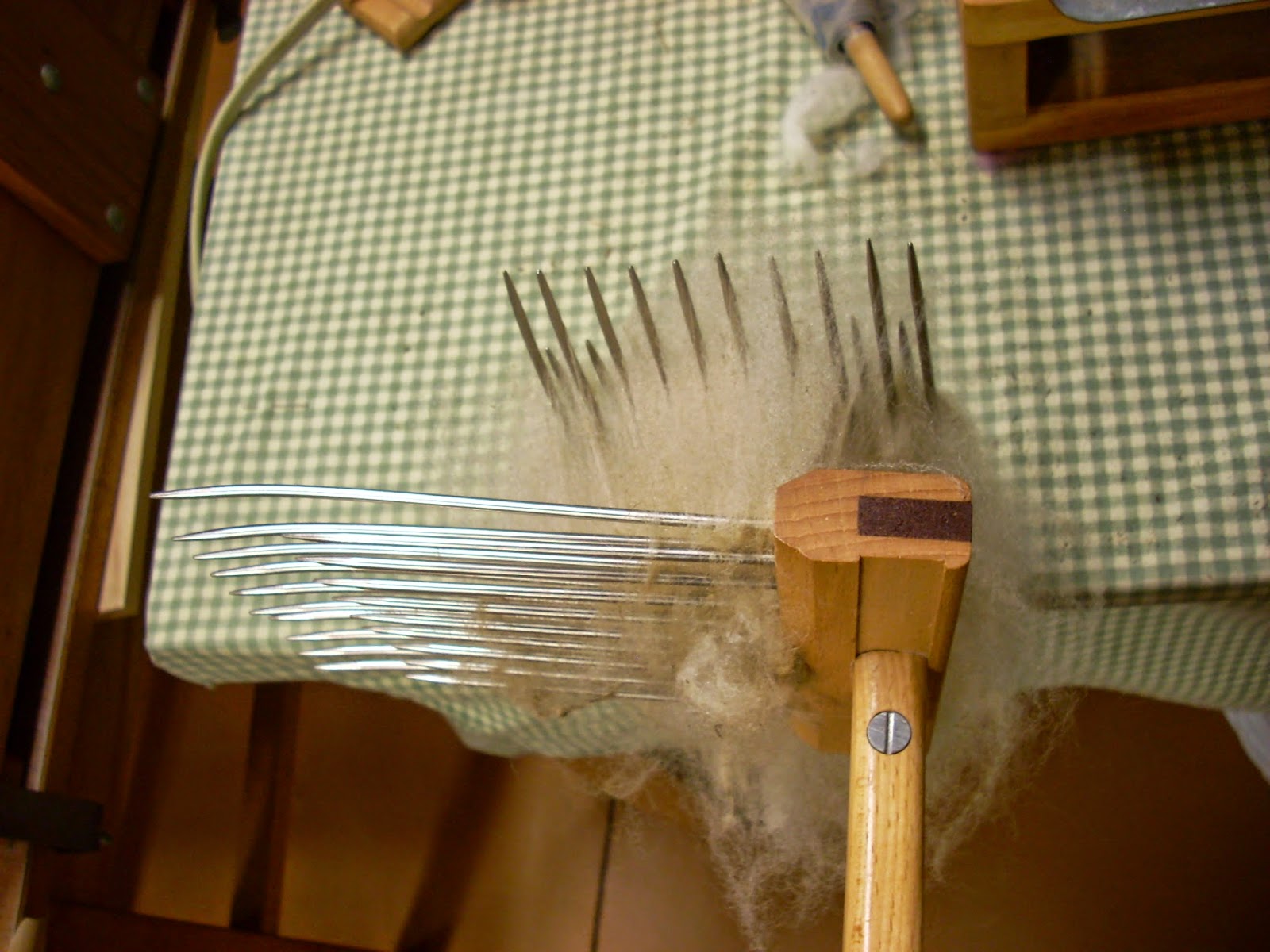
It seems the greatest deterrent to spinning in the grease is the fear that one’s equipment will be ruined by it.  This leads some to believe they should have separate equipment for spinning in the grease.  Obviously, the mechanized carder we usually use to process washed wool would not do will with greasy, dirty fiber.  I opted for the combs.  Youtube led us to believe this is more processing than is necessary to spin raw wool, but the appeal of the combs was that they were handy, and looked relatively simple to clean and difficult to damage.

Getting ready to comb
From my Youtube research, I gathered that there is no one right way to use the combs, but gained some helpful hints on not smashing the wool together in a clump or spearing yourself.

I then set about combing Cinderella’s fleece.  I picked out only the largest pieces of vegetation, letting the combs do the rest.  As I combed it, the short fiber remained behind, set aside for felting, and the vegetation fell through to the floor.
Here we go
From the comb, I used a nifty trick to make roving: pull.  Amazes me every time. 

whoa, magic
Each time, I got a little ball of roving.


When they piled up, I took a break and spun them.  The voices of the internet claim spinning in the grease is easier, smoother, and more enjoyable.  They are correct.  Cinderella spun up rapidly, evenly, and painlessly.  Stay tuned for what happens next!

Sunday, March 2, 2014

Winter Projects


People ask us if we are less busy in the winter than in the summer.  When I am in the middle of winter I think not.  When spring, summer and fall come I think maybe.

Typically in winter we try to catch up on indoor projects that wait for us not to be working outside.  Right now we are watching the thermometer for signs of spring and time for sap to run, and seeing near zero temperatures, it is not time yet.

So, we are finishing up the wood work in the office, which this past year was the focus of restoration and renovation.  Last summer we ripped out the ceiling and walls to install insulation.  We also refinished the floor and enclosed the existing fireplace, not willing to eliminate it entirely. Mary Ann carefully removed the woodwork around windows and doors, stripped off the orange paint, and added natural stain. Next up will be shelves and cupboards on one wall.  A place for everything and everything in its place….

Mary Ann also painted the woodwork at the bottom of the stairs and put a strip of carpeting on the steep stairs to upstairs bedrooms. The laundry room will eventually have shelves added for storage of towels and sheets.

In the Dye Kitchen in the Tesseract we moved a cupboard closer to the stove to hold dye pots, cleared out the stuff that accumulated under the counter and Mary Ann built shelves to accommodate the items we now know are frequently needed for dyeing wool…There is a place for natural dyes, madder root, onion skins, lichen, and dried marigolds, which are beginning to comprise a larger portion of dyed wool.


And, this weekend is building a cupboard to replace the desk behind the door that we now know Marty does not use, and which has a tendency to accumulate stuff .  This will be a place for food related items, tea, cups, bowls, plates etc., keeping it away from the dye stuff.


Our WWOOFers have done a grand job of washing, dyeing and carding bags and bags of wool to be used for wet felting projects and cupboards in the kneewall upstairs are sorted and labeled.  Washed fleeces have been organized and inventoried, samples are posted, and computer records updated.  And new signs made for farmers market ant the store and tons of Thyme Tile  needle felting kits are ready to go.


This week Marty sorted the yarn stash and is finishing a vest and a sweater that have been in process for way too long.  We now have bins of partial balls of yarn sorted by color, and a bin on hand spun waiting to be plyed into yarn.


And Marty is working on needle felted designs for display….

When the weather gets a bit warmer we will move back outside….getting ready for lambing in the barn.

Tuesday, February 11, 2014

Wooly Wet Felting

Mary Ann and I learned about wet felting years ago at Common Ground Fair.  This house in the woods was our first endeavor.


The techniques of wet felting have changed  little over the past 2,000 years.  Then as now you use wool, water, heat and agitation to tangle wool fibers together into an unwoven fabric.


Wet felting involves applying warm soapy water to layers of wool fibers placed in layers at 90 degree angles to one another. Repeated agitation and compression causes the fibers to hook together into a single piece of fabric. Only certain types of fiber can be felted successfully. Sheep's wool is a favorite.
Most types of sheep’s wool, can be used for the wet felting process. wool is covered in tiny scales.  Wetting and soaping the fleece causes the scales to open, while agitating them causes them to latch onto each other, creating felt. Plant fibers and synthetic fibers will not felt.
 After the wet felting process is complete, the felted material may be finished by fulling which includes scouring and thickening. In Roman times, fulling was conducted by slaves working the cloth while ankle deep in tubs of human urine.  Stale urine, known as wash, was a source of ammonium  salts and assisted in cleansing and whitening the cloth. Now soap is used.
Originally, fulling was carried out by pounding the woolen cloth with the fuller's feet, or hands, or a club. In Scottish tradition, this process was accompanied by waulking songs, which women sang to set the pace. Women sat at a table and beat the cloth against it in rhythm. 


Wet felting involves lots of agitation, rubbing, and rolling using bubble wrap or a felting stone.


This shows shaping wool into long ropes...more rubbing!


And voila!  Beautiful bags for everyone. 


Here are some pictures of wet felted items  done by Kathleen, our wet felting guru, by Marty, and by others who took classes here at the farm.
Wet felted bags by Kathleen
Wet felted Slippers, by Kathleen.  Class coming up February 23.  There is room for more....
Marty's bag ready for needle felted embellishment.

Tuesday, January 21, 2014

Its all about Community


Beginning our 7th year with our Fiber CSA in 2014
We have realized our Fiber CSA is all about the people.  Sally, one of our funding members, says she and many of our CSA members believe what we are doing is important and want to help us be sustainable.  We appreciate each individual involved, each in their own way…with different desires and different skills and abilities.   We value flexibility and appreciate people’s desire to support the sustainability of A Wrinkle in Thyme Farm.

In the book, Small Farms are Real Farms, by John Ikerd a chapter is devoted to perceptions vs realities.  The author says, “Successful small farmers pursue a fundamentally different approach to farming than do big farmers.  They reduce their reliance on purchased inputs …They focus on creating value, as well as reducing costs. “  They build relationships with their customers.  As a result they can achieve sustainability. Sustainable farming is about stewardship.  It is about the pursuit of happiness, family, neighbors, and belonging…having a sense of purpose and meaning.  

In the beginning we thought our Fiber CSA  http://www.awrinkleinthymefarm.com/education/fibercsa.html was about the animals and the wool. (Everyone seems to enjoy petting the sheep and meeting Bubba, the gentle draft horse.) We appreciate a nucleus of strong supporters who love coming to the farm, nurturing our animals and knitting farm yarns.   Each has something important to offer: time, creative energy, color awareness, and more. People love seeing the sheep in the barn or the pasture, and the lambs in the spring.  Each and every lamb is named, cuddled, and nurtured to be a friendly part of the farm.


We began our CSA by offering 10 shares, and exceeded the goal in the first year.  Fiber availability is limited by the sheep we have and we always want  to be sure that everyone got a full share of fiber from our own animals.  Since then we have grown to over 40  members.  It is a little hard to count as some members purchase more than one CSA in a year, and others may take than a year to choose their entire share.


When you become a member of our CSA your  share is available to you as you choose. We encourage you to visit the farm to see and feel the choices available if you can. When you visit you may even choose the animal in the field that you want your fiber to come from. If you can not visit we will work with you by sending pictures of the sheep and samples of the fiber according to how you would like to use it to spin, crochet,  knit, or weave.  We also can include a bottle of maple syrup or a pound of Maple Sausage in your share.
There is a core group of knitters that comes to knit each week. CSA members who who are part of this group often immediately renew their shares each time they are used up.  These same people pitch in when they see that help is needed offering to help as mentors, teaching, promoting, advertising and sharing.  

 I think there are as many ways to be involved as there are people.  We are trying to work out ways to incorporate everyone’s skills in a time frame that works for all of us.

Not everyone can come to the farm.  Some order a CSA Share through our Etsy store at https://www.etsy.com/shop/FiberThyme

One Michigan spinner chose a sheep from a picture.  We sent him a sample of the fiber for color and feel.  After he received the roving CSA share he sent a gracious letter of appreciation. One member who likes to felt lives in New York City, and once or twice a year sends words of  appreciation and orders hand dyed felting wool or gifts for friends.

You will literally feel warm and fuzzy when you knit A Wrinkle in Thyme  farm yarn into a scarf, mittens, socks or sweater.  (Farm yarn is created with fiber from our own animals.) The dollars you have invested in our diversified farm will help us provide the best possible care we can give to our  sheep, lambs, and draft horse. 

Friday, April 26, 2013

Needle Felting a Portrait of Ewe


Timmy, a sheep at A Wrinkle in Thyme Farm
This is Timmy, a needle felted portrait.  People who have seen my art on display often ask, how is that done?

Needle felting is actually quite easy.  It begins with a photograph.  I then transfer a line drawing onto a piece of commercial felt that is 100% wool (not easy to find here, so I order it from away by the bolt).  I use wool from our sheep that has been washed, carded, and hand dyed and in this casse I use wool locks (uncarded long curls of wool).  The tools needed include a firm sponge 10x10x2 inches and special felting needles.  The needles, available in various sizes and shapes, all have barbs and a sharp point.  The process involves placing the colors and wool pieces where you want them, a bit like coloring with wool.  You secure them in place by punching repeatedly with the needle until it looks and feels right. To do larger areas you may choose to use a handle that holds several needles.  Much faster!

If you would like to learn more, I will be demonstrating this at our booth on May 11 and 12 at New Hampshire Sheep and Wool festival.

 If you would like to try doing a sheep portrait something like this, register now for a class I will teach on Sunday, Mothers Day, May 12 at 9:30am at the NH Sheep and Wool festival.

To register contact us at info@awrinkleinthymefarm.com.

The class is $75, including the pattern and all the materials needed to complete the project.  You will need a sponge, $38 needles, and a multi needle holder (available for purchase if you don't have them).   This art is really easy and goes pretty fast....no counting, and using natural materials.  Try it...you will like it!

Friday, March 29, 2013

Maine Maple Weekend 2013


This year we had over 200 people come through the sugar house, many of them here for the first time to see the wood fired evaporator in operation with a gravity feed system.  Over the weekend Mary Ann made over 2 gallons of syrup while explaining how the evaporator works.


Wood Fired Evaporator in action


Collecting sap along the road
Overall this year has been a much better sap year than last. The main problem this year was ice in the buckets.  We had to gather ice from the buckets on Thursday and Friday and put the ice in blue barrels inside the Tesseract where the radient heat from the solar panels melted it over a couple of days…this in order to have sap to use for the demonstrations.  We have a bigger holding tank for gathering sap from buckets along the road with the truck, but it is not good for the ice.  

New big sap tank in the pcikup
 A big thanks to Lee Ann, our regular farm hand, and Sophie and Renee, our WOOFers.  Sophie and Renee came to us through our connection with Worldwide Opportunities on Organic Farms (WWOOF), an organization that links willing workers with host farms, facilitating the sharing of knowledge and skills in exchange for room and board on the farm.  For weeks they helped us prepare for the weekend event, tapping trees, gathering sap, making and bottling and tagging maple syrup, cleaning inside the barn, outside, in the sugar house, and in the Tesseract. 


Everyone seemed to lambs in the barn, where Renee, Anna, and Sophrinia offered information and tours to include petting baby lambs just a few days old. 
 
Bubba, the draft horse stood out back, grateful for the carrots and apples offered to him. 

The yearlings, also behind the barn, a week later are still waiting to give birth to their Finn cross lambs.  


Thanks to Barbara, here on her spring break, who  made the kitchen and workshop area ready for guests to enjoy the pancakes and sausage breakfast. 

Thanks also to Jen, who periodically transforms our store into a beautiful sight to behold. 

Both days our fiber CSA members were here to help out. Wendy served by greeting people and organizing parking. At one point on Sunday there were over 20 cars here.Priscilla and Kathleen did an awesome job as cashier in the store while Marty demonstrated spinning and needle felting and answered customer’s questions.


Jan, Edith, Cheryl, Lee, Marianne, and Diane kept the sausage and pancakes coming fresh and hot and washed dishes. We made several 8 big batches of Master Mix for the pancakes.  I guess we need to get more plates from the free store since there were times when all the plates we had were in use.  We planned to serve 20 at a time, and ended up setting up an extra table for more to be seated.

Kathleen’s hubby, Kevin built an awesome fire in the earth oven, our new addition for 2012.  After lunch we enjoyed fresh biscuits baked in 4 minutes flat, and later in the day on Sunday delicious pizza filled our appetites.  Maybe next time we will be able to feed more people.


We appreciated Robin and Patty, friends who were here throughout the weekend to help with whatever needed to be done from splitting wood for the wood fired evaporator to mixing pancake batter and serving tables.

After lunch visitors, including a group of eager children went out into the orchard field and around the stone walls to collect sap.  Everyone seemed to enjoy that.  People seemed comfortable here….sitting around with an extra cup of hot sap tea or maple coffee and chatting with friends.

At the end of the day Sunday, after we gathered up a pair of boots, a jacket, and sunglasses. Guess we need a lost and found department now. If you are missing personal belongings from the weekend call us.

As the Farm event signs came down we evaluated the weekend….make more pancake mix next year, how much sausage to thaw, a sign up sheet so we know how many people come, take more pictures…..by the way, if you got a good picture of your family or children needle felting, gathering sap,  petting lambs, or Bubba, or just being cute we would love to share them on our web site.

We wondered how people found us, heard about us, and decided to come. We appreciate  that so many people came here to help and to enjoy the spring ritual making of maple syrup in Maine. Our thanks to all who made it a great weekend to remember.


The Sugar House

Saturday, February 23, 2013

Tapping our Maple Trees ~ A Team Effort


Might be some snow today, and the sap is running!


This week we have been tapping trees in earnest.  Our goal is about 400 taps, and we don't want to miss a run, so we are starting earlier than usual.  For sap to run it must be below freezing at night and in the high 30's or 40's during the day.

We have WWOOF World Wide Opportunities on Organic Farm participants here. Two young women who are here for a few weeks to help with whatever needs to be done.  They have been eager to learn about producing maple syrup.

We first tapped trees with good sun exposure, which are likely to run the most.  This was trees along both sides of the road.  On the road we used the 2 wheel cart to haul tools and buckets. Christine, one of the participants at our Yarn and Yoga event, and Lee Ann, our regular helper both came to help for the day on Wednesday.  They both agred  it was loads of fun being outside on a beautiful sunny day treking through the snow to the maple trees.

We actually had two teams of 3 the first day.  One to drill the hole and insert the tap, another to hammer it snugly into place, and a third to put on the bucket and the lid.

Next we tapped the cow lane trees and the mid wall, along the edge of the fields. For this we used the sleds to carry what we needed.  Some of these trees are in clusters so we use tubing so that several trees drain into a single 5 gallon bucket.

And today it is snowing. This is a good thing as Bubba will be pulling the pung with the sap tank.  The pung is an antique rig with 2 sets of runners and a box and shaves. The box is big enough for 2 seats, but we take one of them off to make room for the tank.

The next day we did trees more into the woods and along stone walls.  To date we have put in over 300 taps.


Soon we will fire up our wood fired evaporator.  Here is a picture of Mary Ann last year showing a youngster how she keeps the fire fed. 


Maine Maple Sunday will be here before long....it is the 4th Sunday in March each year, so for 2013 it will be March 24.  We will be open at 8am for a pancake breakfast featuring fresh maple syrup and our own maple lamb sausage.  We expect another great team of helpers in the kitchen, lambs in the barn, and helpers to collect sap.


 This is a picture of the Maple Breakfast from 2012.  Good turnout indeed!