
 Annual Mother-Child Farm Sleepover
May 17th - May 18th at
A Wrinkle in Thyme Farm,
Sumner, Maine
Please consider joining us for this unique and relaxing
getaway.
Mothers and children will have opportunity to:
We will meet at 9:30 on Saturday
and leave after brunch on Sunday
Kripalu Yoga taught by Wendy
Youmans, KYT
Creative Kids Yoga and Hoopnotica Hoopdance taught
By Jen Appleby
Register NOW! $150
per mom, $50 per child
To
register print registration form on website and send it with a check to
106 Black Mtn Rd, Sumner ME 04292
or
contact A Wrinkle in Thyme Farm at
info@awrinkleinthymefarm.com or call 207-212-4058. |
Monday, April 28, 2014
Mother/Child Farm Sleepover 2014

Sunday, April 27, 2014
Spinning in the Grease
Renee
here. As you may know, I learned to spin
wool this winter, and I’ve had great fun experimenting. I recently became interested in the
properties of raw wool, specifically, greasy mittens that would be
water-resistant, more so than their washed-wool counterparts. Even on the coldest days this winter, I could
bury my hand in the snow-covered fleece on a sheep’s back and find a warm, dry
critter beneath it. The same could not
always be said for my snowy mittens and hands inside of them.
In
order to spin in the grease, I learned you need a freshly-shorn fleece, before
the lanolin has time to get sticky. I
selected Cinderella’s lamb fleece from our last shearing, in part because she
had nice long fibers (easier to spin), in part because she was very greasy
(that’s the point, right?), and in part because she’s a favorite.
 |
| Cinderella in her fleecy snowy glory |
It
seems the greatest deterrent to spinning in the grease is the fear that one’s
equipment will be ruined by it. This
leads some to believe they should have separate equipment for spinning in the
grease. Obviously, the mechanized carder
we usually use to process washed wool would not do will with greasy, dirty
fiber. I opted for the combs. Youtube led us to believe this is more
processing than is necessary to spin raw wool, but the appeal of the combs was
that they were handy, and looked relatively simple to clean and difficult to
damage.
 |
| Getting ready to comb |
From
my Youtube research, I gathered that there is no one right way to use the
combs, but gained some helpful hints on not smashing the wool together in a
clump or spearing yourself.
I
then set about combing Cinderella’s fleece.
I picked out only the largest pieces of vegetation, letting the combs do
the rest. As I combed it, the short
fiber remained behind, set aside for felting, and the vegetation fell through
to the floor.
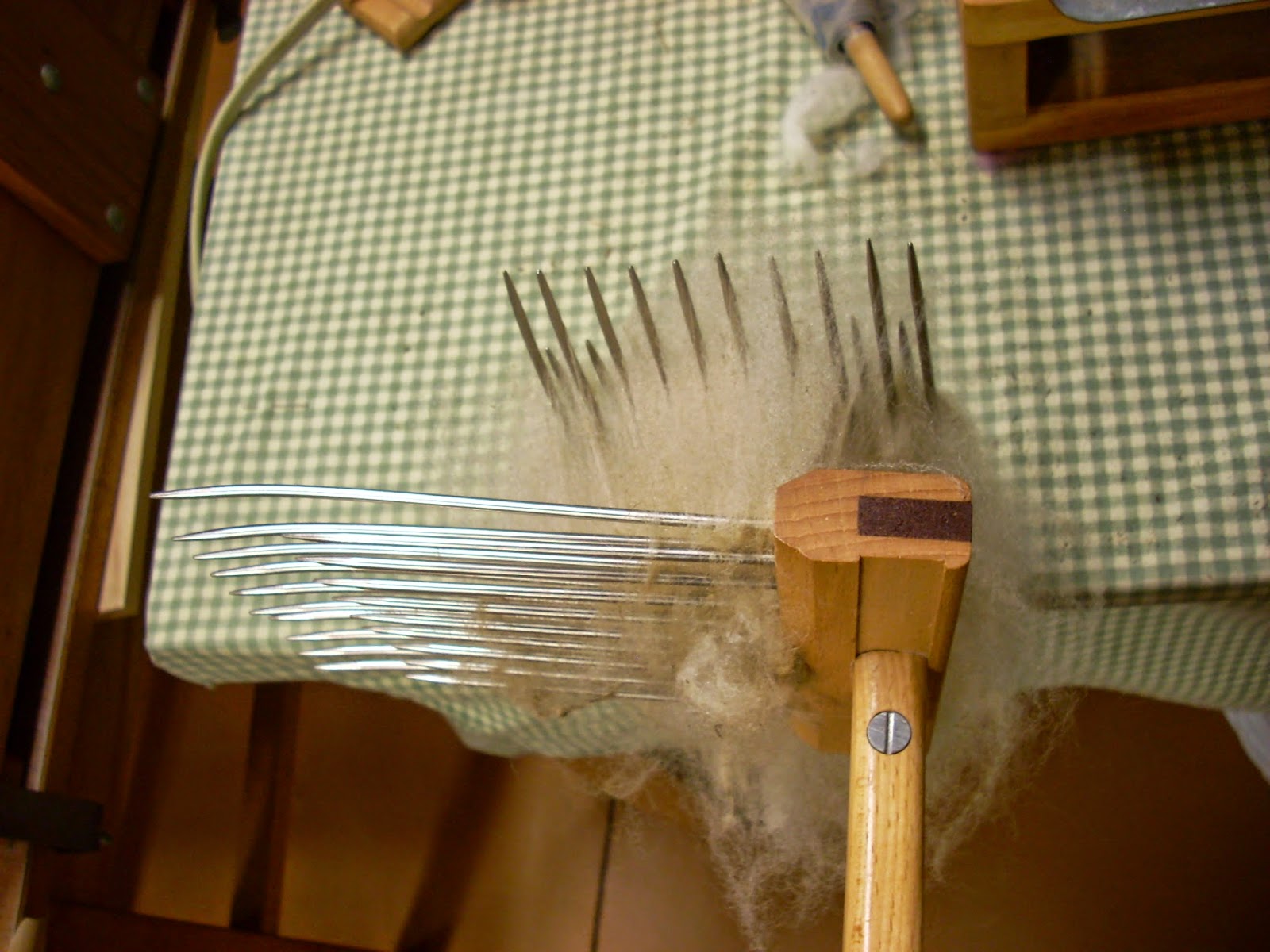 |
| Here we go |
From
the comb, I used a nifty trick to make roving: pull. Amazes me every time.
 |
| whoa, magic |
Each
time, I got a little ball of roving.

When
they piled up, I took a break and spun them.
The voices of the internet claim spinning in the grease is easier,
smoother, and more enjoyable. They are
correct. Cinderella spun up rapidly,
evenly, and painlessly. Stay tuned for
what happens next!
Sunday, March 2, 2014
Winter Projects
People ask us if we are less busy in the winter than in the
summer. When I am in the middle of
winter I think not. When spring, summer
and fall come I think maybe.
Typically in winter we try to catch up on indoor projects
that wait for us not to be working outside.
Right now we are watching the thermometer for signs of spring and time
for sap to run, and seeing near zero temperatures, it is not time yet.
 So, we are finishing up the wood work in the office, which
this past year was the focus of restoration and renovation. Last summer we ripped out the ceiling and
walls to install insulation. We also
refinished the floor and enclosed the existing fireplace, not willing to
eliminate it entirely. Mary Ann carefully removed the woodwork around windows
and doors, stripped off the orange paint, and added natural stain. Next up will
be shelves and cupboards on one wall. A
place for everything and everything in its place….
 Mary Ann also painted the woodwork at the bottom of the
stairs and put a strip of carpeting on the steep stairs to upstairs bedrooms. The
laundry room will eventually have shelves added for storage of towels and
sheets.
In the Dye Kitchen in the Tesseract we moved a cupboard
closer to the stove to hold dye pots, cleared out the stuff that accumulated
under the counter and Mary Ann built shelves to accommodate the items we now
know are frequently needed for dyeing wool…There is a place for natural dyes,
madder root, onion skins, lichen, and dried marigolds, which are beginning to
comprise a larger portion of dyed wool.

And, this weekend is building a cupboard to replace the desk
behind the door that we now know Marty does not use, and which has a tendency
to accumulate stuff . This will be a
place for food related items, tea, cups, bowls, plates etc., keeping it away
from the dye stuff.

 Our WWOOFers have done a grand job of washing, dyeing and
carding bags and bags of wool to be used for wet felting projects and cupboards
in the kneewall upstairs are sorted and labeled. Washed fleeces have been organized and inventoried,
samples are posted, and computer records updated. And new signs made for farmers market ant the
store and tons of Thyme Tile needle
felting kits are ready to go.
 This week Marty sorted the yarn stash and is finishing a
vest and a sweater that have been in process for way too long. We now have bins of partial balls of yarn
sorted by color, and a bin on hand spun waiting to be plyed into yarn.
And Marty is working on needle felted designs for display….

When the weather gets a bit warmer we will move back outside….getting
ready for lambing in the barn.
Subscribe to:
Posts (Atom)
